
Jump to content

PKHeX 31.01.2026

¿Quieres enterarte al momento de las nuevas descargas? Síguenos en Twitter, Mastodon o Threads!

PKHeX es un editor de partidas guardadas, programado en C#, de la serie de videojuegos Pokémon, compatible con títulos de Switch, Nintendo 3DS y GameCube.

Soporta los siguientes tipos de archivo:

  • Archivos de partidas guardadas ("main", *.sav, *.dsv, *.dat, *.gci)
  • Archivos de la tarjeta de memoria de GameCube (.raw, .bin)que contienen las partidas guardadas de los juegos Pokémon de GC.
  • Archivos de juego de Pokémon (.pk*)
  • Archivos de regalo misterioso (.pgt, .pcd, .pgf, .wc*) incluyendo la conversión a .pk*
  • Importación de equipos desde los Battle Videos desencriptados de 3DS
  • Transferencia desde una generación a otra, convirtiendo formatos sobre la marcha.
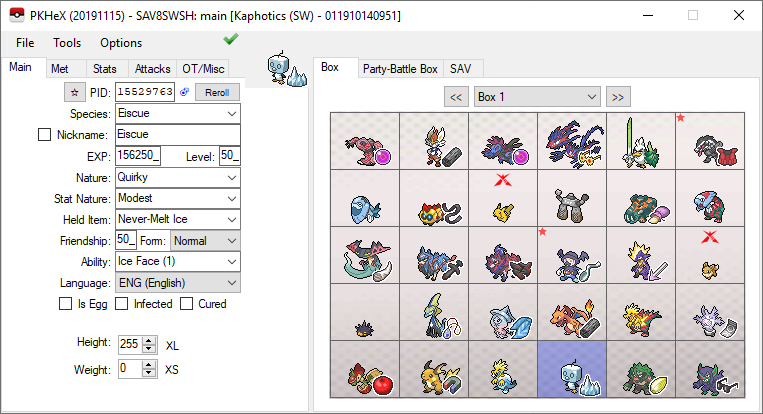
unknown.png.3b3459cdb952cfa441d486317acadae1.png

Los datos se muestran en una vista que se puede editar y guardar. La interfaz se puede traducir con recursos/archivos de texto externos para que se admitan diferentes idiomas.

Los conjuntos de Pokémon Showdown y los códigos QR se pueden importar/exportar para ayudar a compartir.

Los contenedores de datos guardados de Nintendo 3DS usan un AES MAC que no se puede emular sin las claves de 3DS, por lo que se requiere un servicio de renuncia (svdt, save_manager, JKSM o SaveDataFiler).

No apoyamos ni aprobamos hacer trampa a expensas de otros. No uses Pokémon significativamente pirateados en la batalla o en intercambios con aquellos que no saben que se están usando Pokémon pirateados.

PKHeX es una aplicación creada por Kaphotics.


Que novedades incluye la versión 31.01.2026

Released

Legalidad

  • Se ha habilitado la Swampertita; ahora puede estar presente en el inventario o ser equipada por un Pokémon.

Novedades

  • Se ha añadido la gestión de 9.999 Megaesquirlas para la Generación 9a.

Correcciones

  • Se ha corregido el análisis de sets de Showdown, que ahora reconoce los IVs y EVs aunque se introduzcan en un orden no estándar.

No te pierdas nada, síguenos en Twitter, Mastodon o Threads!
Preguntas, aportes y peticiones en el foro.

  • Contenido similar

    • Por Dekuwa
      DBI es solución definitiva para la instalación de archivos NSP/NSZ/XCI con varias características avanzadas para potenciar la experiencia con Nintendo Switch.
      Nota: Incluye la versión original en ruso junto a traducciones no oficiales al español, inglés y francés.
       DBI soporta instalación vía MTP, USB (usando el script dbibackend o la herramienta dbi-nsw), red (sando tu propio servidor http) o memorias USB externas.
      Instalación
      Descarga la última versión de la aplicación desde esta misma página de forma completamente gratuita, descomprime el archivo descargado y copia los archivo dbi.nro y dbi.config a tu tarjeta SD en la ruta /switch/DBI/.
      DBI puede ser ejecutado tanto en modo  applet (desde Album) o en modo aplicación (título). Aun así, está diseñada para utilizarse en primera instancia en modo applet.
      Si has lanzado DBI de forma satisfactoria en modo applet verás una pantalla con fondo azul. En modo aplicación el fondo será negro.
      Usage
      Interface

      Browse SD Card — installation of .NSP / .NSZ / .XCI files from your SD card. Browse USB0 Drive — installation of .NSP / .NSZ / .XCI files from an external FAT32 or exFAT formatted USB drive (will only appear if a USB drive is connected) Install title from USB — installation of .NSP / .NSZ / .XCI from a PC via USB 2.0 or 3.0 cable using the included dbibackend script. Main menu hotkey for this option: Y button. Install title from Gamecard — install a game from gamecard to the console's internal NAND or SD card (will only appear if a gamecard is inserted) Home server — install games over your local network (HTTP) using a LAN USB adapter or WiFi network. For full details see Home server Browse installed applications — view installed titles including base, update, DLC and whether or not a LayeredFS mod is present. Displays your total play time and how many times you've launched the title. Check file integrity for errors, transfer game data between internal NAND and SD card, delete individual or multiple titles and their LayeredFS mods with one click, individually remove updates and DLC and use the Reset Required version function to restore the system update check for the selected game back to base. Main menu hotkey for this option: L button. Cleanup orphaned files — removes all orphaned installed content, tickets and pending firmware updates from the system with one click. Browse tickets — view and manually delete system tickets for games. Run MTP responder — enables DBI's internal MTP server to connect the Switch to a PC or to an Android device (Some tested phone/tablet devices: Pixel 3, Xiaomi Mi A1, Lenovo Tab 4 7 "TB-7304X). On your device you will be presented with several virtual drives for installation and many advanced features for file management on your SD card and NAND. Please see Run MTP Responder for a full overview. Exit — exit from the program. Main menu hotkey for this option: + button The bottom left corner of DBI displays the total amount of data on your currently on your SD card along with the full capacity. The bottom right corner gives you the same information for your NAND's usable space in HOS.
      Bottom center (dbi: XXX) is the DBI version number - you should always use the most recent version.
      Browse SD Card / Browse USB0 Drive
      Select this option if you want to install games, updates and DLC from files that exist on your SD card or external USB drive. Press A to open the folder and B to go back. After opening the folder containing your installation files use the X button to select single or multiple files for installation. The Y button inverts your selections and the color of the name of the selected files will change from white to light blue.
      Press the A button to confirm. A window with installation options will appear:

      Total transfer size — the total amount of data (.NSP / .NSZ / .XCI files) selected for installation. Total install size — the amount of free space required to install the selected files. Install target — data installation location: NAND - internal memory of the Nintendo Switch console, SD - SD card, AUTO - by default this will install to your SD card but if you don't have enough space the installation will fall back to NAND (internal memory). Delete after install — deletes installation files (.NSP / .NSZ / .XCI files) from the source after they have been successfully installed; for this to work, the "Read-only" attribute must be removed from files if present. By default, files are not deleted. The option is visible only when installing from an SD card / external USB drive. Turn off screen — turns off the screen during installation to conserve battery, after installation successfully completes the screen will automatically turn back on. This option only works in handheld mode. Select Start install to begin the installation. After a successful installation Installation Complete. Press B to return will appear. DBI will automatically and immediately remove old updates when installing a new update for a game, so you don't have to worry about the extra space they occupy.
      Install title from USB
      If you cannot use DBI's MTP responder this is another convenient method for installing titles over USB. Installing over USB allows you to transfer files directly from your PC for example, which avoids the inconvenience and of having to first move the file to your SD card and then install it. Compared to using the MTP responder this mode will also allow direct installation of .XCI files.
      Main menu hotkey for this option: Y button.
      In order to use this option you will first require dbibackend (dbibackend.exe for Windows, dbibackend from dbibackend.tar.xz for all). Launch dbibackend, select the files to install, select Start server, connect a USB-C cable from your PC to your Switch and select Install title from USB in DBI.
      From here you will select and install your files on the Switch in the same fashion as using Browse SD Card / Browse USB0 Drive
      To quickly send files or folders with games for installation, right-click on them, select Send from dbibackend and the installation files will be immediately placed in dbibackend's queue. To configure this in Windows, press Win + R, enter shell: sendto and create a shortcut for dbibackend.exe in the folder.
      Home server
      The "Home server" option will appear if the Network install sources section has been configured in dbi.config (more about this file below). You can specify the name of the option as required in the configuration file
      To install games over your network, edit the dbi.config file located in the /switch/DBI/ folder, following the example:
      ; Network install sources [Network sources] ; <display name>=<type>|<URL> Home server=ApacheHTTP|http://192.168.1.47/Nintendo/Switch/ Install any other HTTP server with DirectoryListing enabled on your PC: Apache, Mongoose, Python SimpleHTTP, sheret, rclone, etc.
      Example for nginx on Windows: edit the file /nginx/conf/nginx.conf, registering the address of your Switch in location, instead of the 127.0.0.1 specified in the example (or your entire subnet like 192.168.1.1/24 or 192.168.0.0/16); it can be found on Switch in System Preferences > Internet:
      location / { root html; index index.html index.htm; } location /Nintendo/Switch/ { allow 127.0.0.1; deny all; autoindex on; } Save the config, run nginx.exe, allow the program to access the network, then copy the desired game to the local /nginx/html/Nintendo/Switch/ folder on your PC, and on the Switch select “Home server”. You will now be presented with the usual interface for installing files and you can start installing files over the network. You can stop the web server via nginx -s stop.
      For the server address in dbi.config, you can also use a domain name, for example, your remote VPS - suggested to use with HTTP Basic authentication e.g.: http://user:password@host:port/Nintendo/Switch/
      For example:
      ApacheHTTP|Network repo|http://127.0.0.1/Nintendo/Switch/ ApacheHTTP|WWW VPS repo|http://www.myveryownswitchvpsdomain.su/Nintendo/Switch/ Generate the htpasswd file, put it in /nginx/conf/, then adjust the nginx.conf file as follows:
      location /Nintendo/Switch/ { satisfy all; allow 127.0.0.1; deny all; auth_basic "Password Protected Area"; auth_basic_user_file htpasswd; autoindex on; } Login "switch", password "pwd":
      htpasswd-file:
      switch:{SHA}N/omUzCtg+qoee+x4ttjgIls9jk= Browse installed applications
      In Browse installed applications you can see a list of installed programs, updates and DLC with their occupied space, version (display version and hex version), their titleID, the total game time and the number of launches, the presence of installed LayeredFS mods for the game (for Atmosphére). Main menu hotkey for this option: L button:

      The total number of installed applications (e.g. games and homebrew nsps) is displayed at the top of the screen. Any installed data can be transferred between internal NAND and SD card, it is possible to individually select and uninstall multiple games (b) / updates (u) / DLC (d)together with their associated LayeredFS mods (l) (detected at /atmosphere/contents/) or you can individually select updates and DLC for deletion. The Reset Required version function will force restore the system update check for the selected game back to base (this is also done automatically with installation or removal of game updates):

      By pressing the R button you can sort the game list as you prefer - alphabetically (default) or by last usage. Press the A button to enter the menu of the selected game, the - button deletes the game and its (non-personalized) ticket, the D-pad selects games, the left stick scrolls through the list of games and the ZR and ZL buttons flip through the list of games screen by screen.
      You can also check (verify) games for their integrity by selecting the file to check and then selecting Check integrity
      Cleanup orphaned files
      Cleanup orphaned files automatically cleans unnecessary game files, files from interrupted game installations, downloaded (officially) OFW firmware updates and all unused game tickets if found.
      Browse tickets
      View and delete game tickets. Ticket (or encrypted title key) is special encrypted unique information about the rights to launch the content of the game which is installed in the system during the installation of each game (000 at the end of titleID) / update (800 at the end of titleID) / each DLC. + means the presence of an installed game, [c] - common-ticket (installed game dump or update), [p] - personalized-ticket (game purchased from the eShop)
      You may be able to resolve certain errors with this for example if you know exactly what you are doing. You can remove individual tickets from a specific game and/or its update/DLC.
      In most case it's better not to touch anything here in order to avoid errors in starting games.
      Run MTP responder
      Run MTP responder run the built-in DBI MTP server to connect to your PC or Android device via USB-C OTG (phone / tablet / other devices). Main menu hotkey for this option: X button (same button to exit MTP mode). After successfully connecting the USB cable to the PC and starting the MTP server in DBI, you'll see the following on your computer:

      1: External SD Card, for viewing, copying and deleting files and folders from/to a PC and from/to your SD card. Drop a file larger than 4GB onto the SD card and DBI will automatically split the file into an archived folder, which allows the Switch to see it as a single file, with this you can for example very easily add a >4GB .xci for use in SX OS, or add a >4GB movie for watching in pPlay.
      2: NAND User, viewing, copying files and folders on a PC from the Switch's internal memory to its USER system partition (this partition is read-only).
      3: NAND System, viewing, copying files and folders on a PC from the internal memory of the Switch to its SYSTEM system partition (the partition is read-only).
      4: Installed games, to view installed games.
      В Installed games all installed games are displayed from both in NAND (internal memory of the Switch) and SD card. To dump installed games to your PC in .NSP format, just copy the folder with the name of the game from Installed games to your PC. A common ticket with completely cleared personal information is generated based on your personalized ticket. Your dump will be in separated files - the game itself, the update and DLC. If cheats or mods have been installed for the game, they will be located in the Mods & Cheats folder. You can also dump a single combined multicontent file containing the game itself, the update and all DLC. This file is located right at the root of the Installed gamessection. The generated DBI InstalledApplications.csv is also stored here, with a table of the list of installed games, their TitleID and the current version.
      5: MicroSD install Drop or copy your NSP or NSZ files in this folder. When the transfer is complete the game will be installed on the SD cardof your console. When installing NSZ files, keep in mind that their actual size may differ greatly from their original size after installation: so if for example you start with 2GB free on your memory card and you do not have enough space to install an NSZ of 1GB in size, that is because NSZ files are compressed and must be decompressed for installation.
      6: NAND install: Drop or copy your NSP or NSZ files in this folder. When the transfer is complete the game will be installed on the internal memory of your console. When installing NSZ files, keep in mind that their actual size may differ greatly from their original size after installation: so if for example you start with 2GB free on your memory card and you do not have enough space to install an NSZ of 1GB in size, that is because NSZ files are compressed and must be decompressed for installation.
      7: Saves: Access to all game saves - in accounts (Account), system programs (System), in Background Content Asymmetric synchronized delivery and Transmission (BCAT, for example: events in ACNH), temporary (Temporary), cache (Cache, for example: addons in DOOM), system BCAT (SystemBCAT), - stored in the internal memory of the Switch; in the Installed games folder - save for the currently installed games, Uninstalled games - save from deleted games that were previously launched. From here, you can make a backup of them by copying them to a PC, and also delete unnecessary ones - for this, open the folder with the name of the game you need, then delete the folder with the nickname of your account / Device-save. In order to restore the save, copy them to the appropriate folder from your PC. DBI does not require pre-launching the game to restore a save, however this only applies to regular saves. BCAT or Cache saves require a pre-launch of the game before restoring.
      8: Album: access to screenshots and videos (Album), similar to Nintendo's feature added OFW 11.0.0.
      9: Gamecard: with a gamecard inserted into the Switch you can dump to .XCI or trimmed .XCI on the PC, along with the update built into it if it exists. The personal RSA certificate automatically removed and is dumped separately.
      After activating the MTP server on the Switch a window will appear with your account nickname and its UID, as well as the number of game saves: 
      To turn off the MTP server and exit to the main menu, press the X button.
      Exit
      Exit - exit from the program in HOS, either to hbmenu or bypassing hbmenu directly to the homescreen (this is configured in dbi.config). If DBI was launched from a title / forwarder, the program will restart or remain on a black screen.
      Errors and warnings
      Warnings
      «HASH MISMATCH» — usually this is NOT an ERROR and the game was simply converted from an .XCI and everything is in order. Sometimes if there are problems with the integrity of the file, download it, rehash it, transferring data via a USB cable / port / during the installation process between the PC and the Switch. If the game still does not start or starts with an error, try reinstalling it again, check or replace the USB cable / SD card / change the USB port. DELTA SKIPPED — this is NOT an ERROR but a notification that unnecessary and unused delta fragments in the update file were skipped during installation. «No tickets found. Possibly this NSP was converted from XCI.» — this is NOT an ERROR and the performance of the game will not be affected. This informs you that the files do not include tickets, they may have been dumped from an .XCI file or converted to Standard Crypto. «WARNING» title marked as Application but has AddonContent — this is NOT an ERROR and usually it indicates a non-standard .NSP homebrew game, for example if an AddonContent flag (DLC) was added to the Application title (main game, v0). If the application starts and works then everything is in order. ERRORs
      «Can not find file for ncaid» — The installation file of the game is corrupt (it does not contain the required .nca from the .cnmt list). «Invalid PFS0 magic!» — download the installation file of the game and check its integrity, this file is corrupt. «Received less data than expected» or Installation aborted — data transfer error, recheck and if necessary replace the USB cable / USB port between the Switch and the PC. Also make sure you have the most recent version of the DBI installed. «std::bad_alloc» — rename the file without special characters and Cyrillic in the name and path to it, plus make sure that you are using the latest version of DBI and that the latest supported version of OFW and CFW is installed on the console. «Nothing to install» in the file selection window - rename the file without special characters, hieroglyphs or Cyrillic in the name and path to it. «INVALID LENGTH» — check the USB-C cable connection to your USB port, try with another USB-C cable, check the integrity of the game file and the SD card for errors, when installing via MTP - try to run DBI in application mode (title override) holding the R button while launching a title. «[FAILED] Unknown error» when installing .tik (ticket) - add the latest sigpatches for Atmosphére. «605: Content or placeholder path not exists» or «SOME CONTENTS ARE MISSING» — broken file system on your SD card, or a non-working / low-quality flash drive. Check it in chkdsk and h2testw, if there are no errors reformat to FAT32. WARNING! Extra buffers exceeded, when installing via MTP - try to run DBI in application mode (title override) holding the R button while launching a title or alternatively via NSP forwarder and use a faster microSD card with a different USB cable / port. No tickets found but they are required — incorrect (incomplete, no ticket but with titlerights) dump of the game, use another one. SOME CONTENTS ARE MISSING. APPLICATION WILL BE UNUSABLE — container is incomplete, check the integrity of the game installation file. dbi.config
      The dbi.config file was added starting with version 253. It is located next to DBI.nro and replaces the old flags files dbi.default.asciiand dbi.network.config and also adds several new options for easy customization of settings for the user.
      Let's take a look at its contents:
      ; General settings [General] ; Use libnx's default font for ASCII symbols DefaultASCII=true ; Use libusbhsfs for access to USB mass storage drives connected to switch or dock UseLibUsbHsFS=true ; Direct exit to homescreen ExitToHomeScreen=true ; Visibility of main menu items [MainMenu] ; Browse and install files from MicroSD card BrowseSD=true ; Browse and install files from USB flash drives and HDD USBHost=true ; Browse and install files from PC via dbibackend BackendInstall=true ; Install game from inserted game cartridge GameCard=true ; Browse and install files from configured network sources Network=true ; Browse installed applications BrowseApps=true ; Clean up files left from bad installs/old updates/unused tickets and so on Cleanup=true ; View where you can view or delete installed tickets Tickets=true ; MTP responder MTP=true ; Install options [Install] ; Check NCA hash during install CheckHash=true ; MTP options [MTP] ; Log all files, id disabled transfer shows only for files >= 4M LogAllFiles=false ; Show or not NSP that includes base game, latest update and all DLC in single multi-title file ShowCombinedNSP=true ; Show or not virtual "Mods & cheats" folder that redirects to sdmc:/atmosphere/contents/TITLEID ShowMAC=true ; Show user defined shortcuts to MircoSD folders as separate storages CustomStorages=true ;Enable or disable various MTP storages [MTP Storages] 1: External SD Card=true 2: Nand USER=true 3: Nand SYSTEM=true 4: Installed games=true 5: MicroSD install=true 6: NAND install=true 7: Saves=true 8: Album=true 9: Gamecard=true ; Network install sources [Network sources] ; <display name>=<type>|<URL> ;Home server=ApacheHTTP|http://192.168.1.47/Nintendo/Switch/ [MTP custom storages] ; <display name>=<path> ;Homebrew=sdmc:/switch General settings
      DefaultASCII - true includes a standard font, false includes an alternative font UseLibUsbHsFS - true enables libusbhsfs library for working with external USB drives via USB-OTG on Switch, false disables it. ExitToHomeScreen — if false, the exit from DBI occurs in the hbmenu, if true, to the Switch's home menu MainMenu
      Shows the corresponding menu items.
      true - display in main menu, false - hide from main menu
      BrowseSD - item "Browse SD card, to install games from Sd card USBHost - item "Browse USB0 Drive, to install games from an external USB BackendInstall - item "Install title from USB, for installing games from PC via backend GameCard - item "Install title from Gamecard, to install the contents of the cartridge in the memory of the console Network - item "Home server, to install games from a home web server BrowseApps - item "Browse installed applications, to manage installed applications Cleanup - item "Cleanup orphaned files, to clean up" orphaned "files from the memory card Tickets - item "Browse tickets, to manage tickets MTP - item "Run MTP responder, to start MTP Install
      CheckHash — if true, hashes of .nca files are checked when installing games on the Switch, if false, no. MTP
      LogAllFiles — false disables logging of all files when working with MTP; if true, all files are logged, even those that are less than 4MB. ShowCombinedNSPInInstalledGames — false disables display of combined (multi-title .NSP-file) titles. ShowMACInInstalledGames — false turns off the display of the virtual directory "Mods & cheats" in the Installed games item in the MTP, redirecting along the path /atmosphere/contents/%titleid_game% to the memory card. CustomStorages - show or hide storages, listed on MTP custom storages section MTP Storages
      Show relevant items when MTP Responder is running on PC / Android, by default all items are enabled for display.
      true - display in MTP on PC, false - no
      The item names correspond to the titles of the sections
      Network sources
      Names and addresses are set for installing games over the network (via WiFi / LAN adapter)
      MTP custom storages
      Custom items for MTP mode for quick access to folders on your memory card. Format: <folder display name> = <path>, for example: Homebrew = sdmc: / switch. In MTP mode, a Homebrew folder will appear, referring to the switch folder on your memory card
      Other possibilities
      Mounting the content of installed titles via MTP
      Go to "Browse installed applications" -> Choose apps you need to mount with X -> Press A -> "Mount contents via MTP"
      by rashevskyv.
    • Por Dekuwa
      AeroFoil es un gestor de bibliotecas de Nintendo Switch que convierte tu colección en una tienda de Tinfoil autoalojada y totalmente personalizable.
      El objetivo de este proyecto es gestionar tu biblioteca, identificar cualquier contenido que falte (DLC o actualizaciones) y proporcionar una forma sencilla de navegar por tus contenidos.
      Algunas de las características incluyen:
      autenticación multiusuario interfaz web para la configuración interfaz web para explorar la biblioteca identificación de contenido mediante descifrado o nombre de archivo personalización de la tienda de Tinfoil El proyecto aún está en desarrollo, por lo que es de esperar que algunas funciones fallen o cambien sin previo aviso.
      AeroFoil es un proyecto encabezado por luketanti.
    • Por Dekuwa
      SysDVR es una modulo experimental del sistema (sysmodule) para Switch que nos permite capturar el juego que se está ejecutando a un PC.
      Existen dos versiones, una que hace el stream vía USB y otra que lo hace a través de la red (TCP). Por ahora no es posible usar las dos al mismo tiempo.
      Usar mpv player es la opción más recomendada para capturar, así como cualquier otro reproductor que tenga soporte para stream h264 en raw vía tcp o stdin, aunque habría que configurarlo manualmente.

      Limitations
      Video quality is fixed to 720p @ 30fps with h264 compression (hardware limit) Audio quality is fixed to 16bit PCM @ 48kHz stereo. Not compressed Only works on games that have video recording enabled (aka you can long-press the capture button to save a video) Video and audio are two different streams, they're likely to desync as they require two different player instances. Vlc does support a secondary audio stream but i didn't manage to get it working properly. Only captures game output. System UI, home menu and homebrews running as applet won't be captured Video feed is not realtime, there will always be a minimum of ~1 second of delay. Stream quality depends heavily on the environment, bad usb wires or low wifi signal can affect it significantly. Stream quality is also affected by software configuration, more details at the bottom. USB streaming is not available when docked Requires firmware >= 6.0.0 Clearly with these limitations this sysmodule doesn't allow "remote play" and does not replace a capture card.
      Usage
      Setting up the sysmodule
      The provided builds already contain the correct file structure, you should just be able to extract them to your sd card.
      To remove the sysmodule just delete the atmosphere/titles/00FF0000A53BB665 folder from your sd card.
      CFWs other than atmosphere should work but i won't provide support for them.
      Network streaming
      This is the easiest way to stream, In this mode the sysmodule is completely standalone, you should be able to play the video stream just by running mpv tcp://<switch ip address>:6666 --no-correct-pts --fps=30 and mpv tcp://<switch ip addr>:6667 --no-video --demuxer=rawaudio --demuxer-rawaudio-rate=48000 for audio.
      When using network streaming it's not recommended to stream both audio and video at the same time as it may cause slowdowns. In general network streaming has more lag and delay compared to USB, it is worth the time to set it up, especially for gameplay recording.
      USB streaming
      To stream via usb you need the UsbStream program, it's built using dotnet core 3.0 and is compatible with linux as well.
      First of all you should make sure your drivers are set up correctly (only the first time) :
      Driver setup on windows
      On windows you may get the device not found or unsupported driver errors or very bad performance on the stream, in this case you may have the wrong driver set up, download zadig and install the libusb-win32 driver for the "Nintendo Switch" device. This won't interfere with other application that communicate with the switch via usb as this sysmodule uses a different product id.
      Driver setup on linux
      On linux you may have errors about loading the libusb-1.0 library, this happens when the file name is different than the one expected by dotnet, you can make a symlink as described on the LibUsbDotNet repo:
      sudo find / -name "libusb-1.0*.so*" and then
      cd /lib/x86_64-linux-gnu sudo ln -s libusb-1.0.so.0 libusb-1.0.so (Example commands, change the paths with the one you find on your pc)
      Streaming
      UsbStream supports three streaming modes:
      mpv or stdin : pipes the received data directly to a video player via stdin, this will use no caching so you'll have low delay but it may lag. Using mpv will automatically add the needed configuration for mpv, stdin will require you to type the args to pass to the player tcp : opens a tcp server so players can connect to it and use their own caching mechanism to remove or reduce lag (at the price of an higher delay) file : writes the received data directly to a file so it can be converted to a common format later. Launch UsbStream like this: UsbStream video <streaming mode> <arg> audio <streaming mode> <arg>
      When using mpv the arg is the mpv executable (.com file on windows) path, you have to repeat it twice if using both streams.
      The tcp option requires a free port number and the file option the output file path.
      To disable a stream just omit the name and its fields.
      Example commands:
      UsbStream audio mpv C:/programs/mpv/mpv : Plays audio via mpv located at C:/programs/mpv/mpv, video is ignored UsbStream video mpv ./mpv audio mpv ./mpv : Plays video and audio via mpv (path has to be specified twice) UsbStream video tcp 1337 audio file C:/audio.raw : Streams video over port 1337 while saving audio to disk
      Note that on windows you should use the mpv.com file and not mpv.exe, omitting the extension will automatically use the right one Launching UsbStream without any parameter will display more options and examples.
      To connect to the tcp streams you can use: mpv tcp://localhost:<video port> --no-correct-pts --fps=30 for video and mpv tcp://localhost:<audio port> --no-video --demuxer=rawaudio --demuxer-rawaudio-rate=48000 for audio
      Tips
      To get the most out of this sysmodule you have to do a lot of testing to find the best configuration that works for you, here are some tips and answers to common issues :
      If the video stream doesn't start immediately try moving the camera around in the game, to display something the video player needs to acquire a video keyframe first If the stream is very poor try a different usb cable and driver with zadig, for network stream bring your console closer to the router, try using a lan adapter or windows' own hotspot mode. An usb 3 wire is slightly better than usb 2, but both should work. Quality also depends on the cpu utilization of the game you're running, OC can improve performances. Using cache will reduce lags at the cost of an higher delay, for mpv it's on by default (except when using usb stream with mpv mode), if you want to try without it the command line arg for mpv is --cache=no --cache-secs=0. There's a lot of room for experimenting here, try different values to find the combination that works best for you. If using no caching when the screen goes full black or white (eg loading screens) it may cause some desync and the stream will start to drop frames, eventually it will fix by itself but it could take some time, the fastest solution is to open the home menu for a few seconds and then resume the game, for usb stream you can try setting the --desync-fix flag (this will introduce glitches). Known issues/TODOs
      Memory usage is kept as low as possible (512K for usb ver, 3MB for network) but running this with many other sysmodules, or ones particulary heavy like sysftpd will not work or hang your console on boot. The usb version stops working when launching another homebrew that requires usb access like nxmtp or goldleaf. Implement a key combination to reinitialize usb when this happens (?) Merge the usb and network stream versions and make an homebrew app to toggle between the two Improve automatic desync detection and fix for UsbStream Credits
      Everyone from libnx and the people who reversed grc:d and wrote the service wrapper, mission2000 in particular for the suggestion on how to fix audio lag. mtp-server-nx for their usb implementation by exelix11.
    • Por Dekuwa
      PKVault es una herramienta de almacenamiento de Pokémon y manipulación de partidas guardadas basada en PKHeX. Similar a Pokémon HOME, tanto de forma local como en línea.

      Funciones por lotes
      Almacenamiento y manipulación de partidas: compatible con todos los juegos de Pokémon, desde la primera generación hasta Leyendas Pokémon: Z-A. Movimiento de Pokémon entre partidas: permite trasladar criaturas de un archivo de guardado a otro. Conversión de Pokémon a cualquier generación: (por ejemplo, de la séptima generación a la segunda). Almacenamiento externo: permite guardar Pokémon fuera de las partidas mediante bancos y cajas. Variantes múltiples: permite el uso de varias "variantes" para los Pokémon almacenados. Acciones de movimiento y borrado. Edición: permite modificar movimientos, EVs y motes. Evolución: permite evolucionar Pokémon que requieren intercambio o intercambio con objeto (por ejemplo, Kadabra -> Alakazam). Vinculación: conecta un Pokémon de la partida con todas sus variantes, compartiendo datos como la experiencia y los EVs. Copias de seguridad: realiza un respaldo de todas las partidas y del almacenamiento antes de cualquier acción de guardado. Listado de copias de seguridad. Restauración siempre disponible. Pokédex centralizada basada en todas las partidas registradas: Vistas con formas y géneros. Múltiples filtros: nombre de la especie, avistado/capturado/en propiedad, tipos, etc. Posibilidad de crear una "Living Dex" (Pokédex viva). Posibilidad de crear una "Shiny Dex" (Pokédex variocolor). Listado dinámico de partidas basado en rutas y patrones de búsqueda. PKVault es un proyecto encabezado por Chnapy.
    • Por Dekuwa
      Cyberfoil es un instalador de NSP, NSZ, XCI y XCZ con soporte básico de eShop para Nintendo Switch.

      Características
      Instala archivos NSP/NSZ/XCI/XCZ y archivos NSP/XCI divididos desde tu tarjeta SD. Instala archivos NSP/NSZ/XCI/XCZ a través de LAN o USB desde herramientas como NS-USBloader. Instala archivos NSP/NSZ/XCI/XCZ a través de internet mediante URL o Google Drive. Instala archivos NSP/NSZ/XCI/XCZ a través de MTP (transferencia de archivos por USB). Verifica los NCA mediante la firma del encabezado antes de instalarlos. Instala y gestiona los últimos parches de firma de forma rápida y sencilla. eShop compatible con Ownfoil con secciones, búsqueda y previsualización de carátulas. Modo OLED para fondos en negro puro. Fork de Awoo Installer. Basado en Tinfoil. Utiliza Plutonium de XorTroll para una interfaz gráfica atractiva. ¿Por qué?
      Porque Tinfoil ya no recibe soporte y no se actualiza para las nuevas versiones de firmware. Si quieres realizar otras tareas como gestionar tickets instalados, títulos y cuentas de usuario, ¡echa un vistazo a Goldleaf!
      eShop de Ownfoil
      CyberFoil es compatible con una eShop de Ownfoil que incluye secciones, búsqueda y previsualización de carátulas. Fork de Ownfoil mejorado para funcionar con esto -> Ownfoil.
      Configuración:
      Ejecuta Ownfoil y anota su host/puerto (ejemplo: http://192.168.1.2:8465). En los ajustes de CyberFoil, establece la URL de la tienda, el nombre de usuario y la contraseña (opcional). Si tu tienda es privada, asegúrate de que las credenciales sean correctas. Navegación:
      L/R cambia de sección (Novedades, Recomendados, Actualizaciones, DLC, Todo, Instalado). ZR busca en la sección "Todo". El panel de la derecha muestra la carátula de la entrada seleccionada. La sección "Instalado" utiliza un diseño de cuadrícula con navegación mediante la cruceta. Pulsa A para ver los detalles. En el modo cuadrícula, los títulos seleccionados muestran un resaltado verde y una superposición de selección. Actualizaciones y DLC:
      Las actualizaciones y DLC solo aparecen cuando el título base está instalado. La lista de actualizaciones solo muestra aquellas que son más recientes que la versión instalada. Flujo de instalación:
      Selecciona uno o más títulos base y pulsa Plus para instalar. CyberFoil puede preguntar si deseas incluir las actualizaciones disponibles para los títulos seleccionados. Notas:
      No se admiten respuestas encriptadas de Ownfoil. La sección "Instalado" enumera el contenido que ya está en la Switch y no se puede instalar desde ahí. La lista de la tienda se guarda en caché para un inicio más rápido (TTL de 5 minutos). Usa X para refrescar. Notas de ajustes
      El modo OLED utiliza fondos de interfaz en negro puro. Actívalo en Ajustes. "Remove anime" oculta el arte de la mascota. Los sonidos se pueden desactivar en Ajustes. Puedes sustituir los sonidos colocando success.wav y bark.wav en sdmc:/switch/CyberFoil/. La caché de iconos de la tienda se guarda en sdmc:/switch/CyberFoil/shop_icons/. Entrada táctil: toca los elementos en el menú principal y en los ajustes para seleccionar. Cyberfoil es un proyecto encabezado por luketanti.
×
×
  • Crear nuevo...